Under the stars
The swag loop
Our pick
- Nights2 or 3
- SleepSwag by the fire
- RefundUp to 7 days before
Guides
Language
Currency
Check open spotsfrom $557 · no cancel feeGroup price calculator
3-day camping tour: Uluru, Kata Tjuta and Kings Canyon
★ 4.8 · 385 reviews total
3 options compared
Choose your group size to see the swag, tent and Mereenie fares together.
≈
View≈
View≈
ViewAll amounts are from-prices on GetYourGuide, converted at the ECB reference rate. Exact prices are shown at booking.
An Uluru camping tour of 3 days packs two dawns, two campfires and three very different landscapes into one loop. Here is how the days run, where the hours go and what to carry.
Editorial team, ulurucampingtour.com · Updated November 8, 2026 · Reading: 7 min
Main facts
The 3 day Uluru camping tour this site books has two doors in. In Alice Springs the coach collects you near 6 am, and the first leg heads south to Yulara for 4.5 hours, breaking for an early lunch. From Yulara or Uluru Airport the pickup is between 1:40 and 2 pm, and your flight must land before 1:45 pm. Those joining at Yulara buy their own lunch first.
Packing happens before any of that. The listing sets a strict 15 kilogram limit: one small to medium soft bag or backpack and a small daypack that rides inside the vehicle. That rules out a hard suitcase, so if you are carrying one for the rest of your trip, leave it at your hotel or store it before pickup. The listing names 22 pickup points, most of them hotels and hostels in Alice Springs.
The guide speaks English and an audio guide covers French, Spanish, Japanese, Korean and German. The itinerary also warns that it can change with seasonal conditions, weather extremes and the requirements of the Traditional Owners or the national park. Treat the plan below as the normal shape of the trip, not a promise of every stop on every date.
Distances on the loop
| Leg | Distance or time | Source |
|---|---|---|
| Alice Springs to Uluru | 465 km, about 5.5 hours8 | Parks Australia |
| Yulara to Uluru | 20 minutes9 | Parks Australia |
| Yulara to Kata Tjuta | 45 minutes9 | Parks Australia |
| Kata Tjuta to Uluru | 50 km by road6 | Parks Australia |
| Uluru to Watarrka | About 3 hours10 | Tourism NT |
| Yulara to the airport | 10 minutes9 | Parks Australia |
Driving times are the park and tourism bodies' own estimates; the tour coach sets its own pace.9
The first stop is Kata Tjuta, where the tour spends about 2 hours on a guided walk among the domes. There are 36 of them, covering more than 20 square km and rising up to 546 metres above the plain.2 In Pitjantjatjara the name means many heads.3 Walk quietly between the domes and let the guide set the pace.
Respect shapes how you behave there. Anangu ask visitors to stay on the marked tracks, and at Walpa Gorge they ask that both sides of the gorge stay in the frame of any photo or film, so no sacred place is revealed.4 On the Valley of the Winds walk they ask for no photos or video of Kata Tjuta at all.5 Your guide will tell you where the camera can come out.
The drive back towards Uluru takes in the late light. Kata Tjuta lies 50 km by road from the rock, and the tour reaches Uluru for sunset with a light snack, about an hour of watching the colour change.6 Five viewing areas in the park are set aside for dawn and dusk.7 Then it is back to camp for a shared dinner and the first night in a swag.
Where the hours go
Durations as the listing itinerary states them; the drive from Alice Springs applies only to that start.
No tour camps inside the national park: Parks Australia says there is nowhere to camp in it, and the nearby Ayers Rock Resort at Yulara runs the campground.1 The itinerary for the tour lists breakfast and dinner at the camp at Yulara. The park itself closes at night, and every visitor has to be out by closing time.12
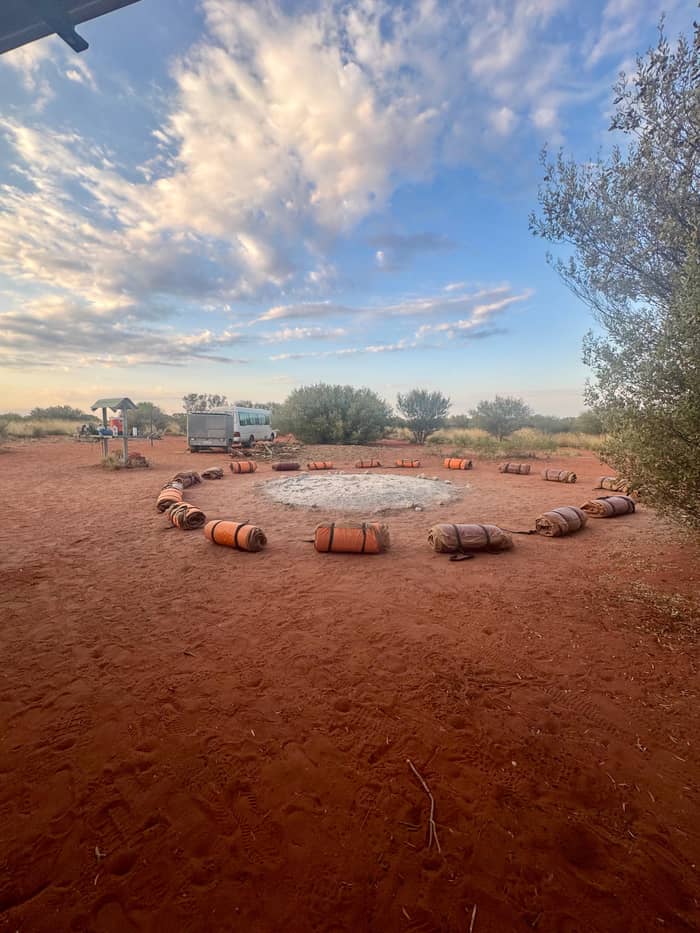
Bed is a traditional swag near the fire: a canvas roll with a mattress inside, spread straight on the ground. In winter that ground gets cold. On July nights the NOAA station 2.5 km from Uluru logs an average of 4.7 C, and the coldest can sink to minus 7 C.13,14 The listing asks for warm clothing in winter and a torch for moving around camp after dark. Sleep in a beanie and dry socks, and keep tomorrow's layers inside the swag so they are warm at dawn.
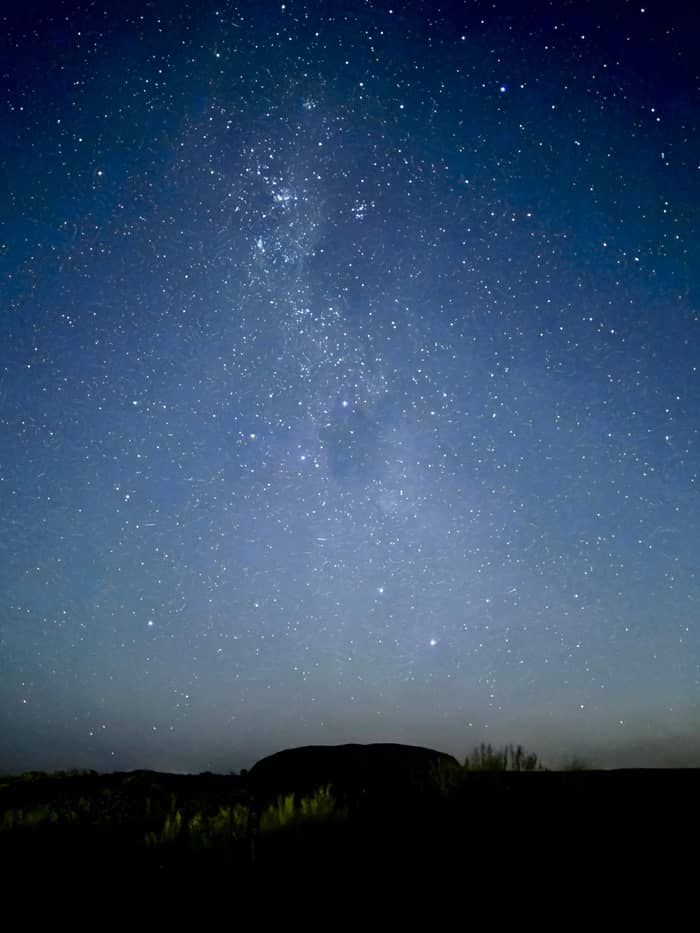
The sky is the reward. Once the camp lights go down, the desert gives you a view of the Milky Way that city skies never give. Stargazers have no choice anyway: with the gates shut after dark, every night shot of the sky is taken from beyond the boundary.15 Your camp, outside the gate, is exactly where the stars belong.
Two nights or three
Tell us how you leave the Red Centre and see which ending fits.
If I fly home from Alice Springs
The 2-night version
The shorter version is back in town by about 6 pm on day 3.
If I fly home from Uluru
The 3-night version
You are dropped at the terminal or your Yulara bed near 9 am on day 4.
If I want one more sunset
The 3-night version
The evening of day 3 is free in Yulara, with a last sunset an option.
If I am arriving by plane at Uluru
Join at Yulara
Pickup is between 1:40 and 2 pm; land before 1:45 pm.
If I do not want to sleep on the ground
The eco-tent loop
The same day plan with eco tents instead of swags, from $697.
Same loop, three ways
Under the stars
Our pick
A roof overhead
Same day plan
Different road home
Back via the loop road
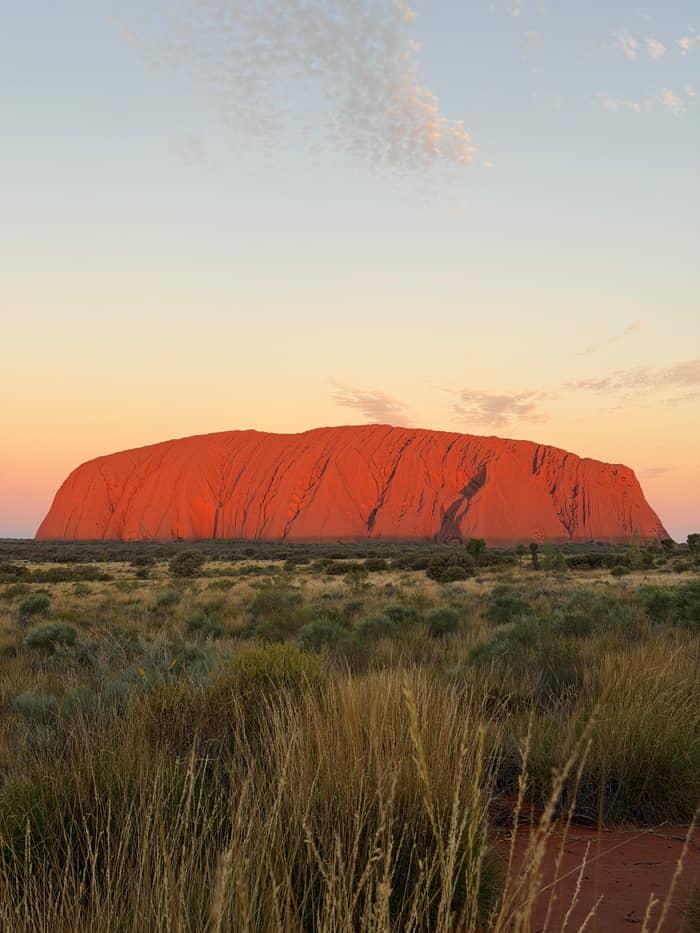
The second day starts in the dark. In June and July the park opens at 6.30 am, so a winter sunrise is a cold, early, quiet hour with a hot drink in hand.19 After sunrise your guide takes the group to a significant cultural site to talk about Anangu rock art and creation stories. Listen closely: what you hear there is shared on purpose, and some stories are not.
Then comes the full Uluru Base Walk, done at your own pace. Parks Australia grades it 3, measures the loop at 10.6 km and allows about 3 hours 30 minutes.20 The advice is to set off early from the Mala parking area and keep the rock on your right, clockwise.11 On the south side you reach Mutitjulu Waterhole, among the rare spots where water lasts all year.21
Carry more water than feels sensible. Rangers ask for a litre or more per walker each hour, and the operator wants a bottle holding 3 litres in your pack.22 The rock is 348 metres high and 9.4 km around, so the walk never feels like the same view twice.23,24 Stay on the track and respect the signed areas where photos are not allowed.25
Hour by hour
Early afternoon
Between 1:40 and 2 pm; from Alice Springs about 6 am.
Afternoon
About 2 hours on a guided walk among the domes.
Sunset
About an hour with a light snack, then dinner at camp.
Dawn, second day
Then the full base walk at your own pace.
Afternoon
About 3 hours by coach to the second camp.
Last morning
About 3 hours guided, then 4 hours on the road.
After lunch the tour stops at the Cultural Centre for about 30 minutes, to see artworks and hear stories from the desert peoples of the region. Its doors are open daily between 7.00 am and 5.45 pm.26 It is also the best place to learn a greeting: Anangu say palya, a word that can also mean welcome, thank you and goodbye.27
Then the coach heads north for about 3 hours to a campsite near Watarrka National Park. Tourism NT puts Watarrka about 3 hours by road from Uluru.10 The road crosses open desert, and it is a good time to sleep, read or watch the landscape go by. Ask your guide about the plants and the country you pass; this is where much of the trip's storytelling happens.
The second camp has the same rhythm as the first, with dinner and a night under the desert sky. It sits outside Uluru-Kata Tjuta National Park, in different country, far from the lights of the resort town. Set out your clothes for the morning before you sleep: the canyon start is early, and the walk ahead is the hardest of the trip.
Video
Katy Does Travel on YouTube · The video waits until you tap play to load.
We recommend you start the base walk from the Mala carpark in the early morning, while it’s cool.
Your daypack
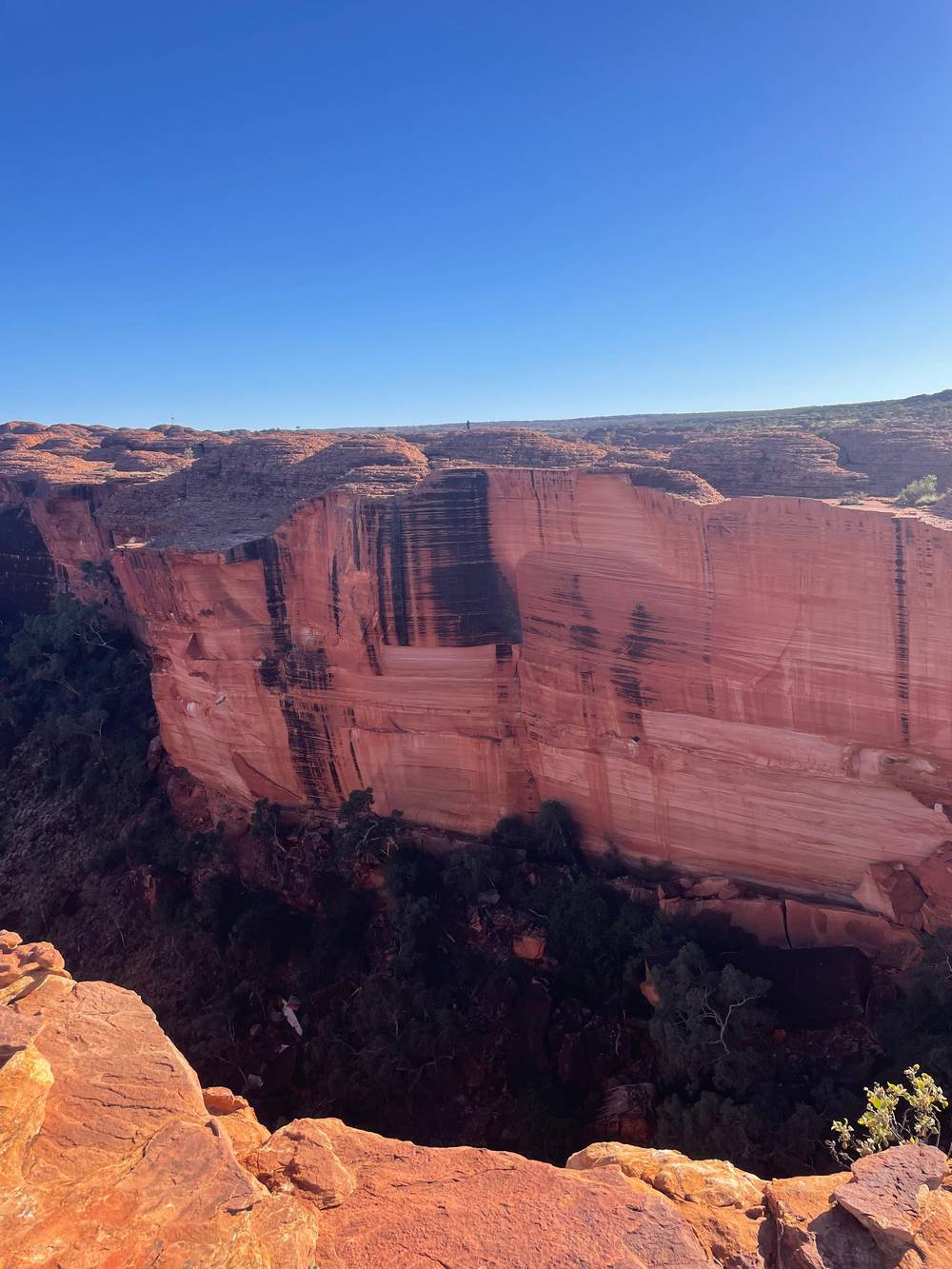
The last morning belongs to Kings Canyon. The tour gives about 3 hours to the guided Rim Walk, naming the Lost City, the Garden of Eden and the Amphitheatre among its stops. The canyon walls rise around 100 m, according to Tourism NT.10 The canyon deserves its own guide, and on a trip camping at Uluru and Kings Canyon it makes a fine last chapter.
Watarrka is a Northern Territory park, so visitors from interstate and overseas need an NT Parks Visitor Pass there, separate from the Uluru pass.18 An adult pass costs AUD 10 for a single day.28 Ask the operator whether passes are covered, since Tourism NT says a guided tour may include them.17 If you buy your own, do it before the trip: the camp near the canyon is no place to hunt for a signal.
After lunch the coach sets off for about 4 hours. On the 2-night version you arrive in Alice Springs at about 6 pm on the third day. On the 3-night version you return to Yulara in the late afternoon, with a free evening there before the final morning. Book any onward flight with that arrival time in mind.
The 3-night option adds one more night and a slow start. Breakfast is at camp, then a transfer takes you to Yulara accommodation or to Uluru (Ayers Rock) Airport, and the tour finishes at about 9 am. If your flight leaves later, the listing notes that luggage can be left at Desert Gardens Hotel while you explore.
The free evening before it is yours to fill. The listing names Field of Light, camel sunset rides and the drone show as options at your own expense, or a last Uluru sunset. A free resort bus loops between the hotels and the town square, so an evening out needs no car.29 Book any paid extra a day or two ahead, as they can fill up.
Is the extra night worth it? It costs you a night in Yulara and gains you a calmer end, a same-day flight from the airport next door, and an evening at the rock without a schedule. If your flights allow it, the 3-night version is the calmer way to finish, with a morning that ends at the airport rather than a long evening on the highway. It also gives you one last look at the rock in daylight before you fly.
FAQ
The domes of Kata Tjuta, dusk and dawn at Uluru, its full circuit, the Cultural Centre and the canyon rim.
Then 4.5 hours on the road south to Yulara, with a break for an early lunch.
The group gathers between 1:40 and 2 pm; arrivals after 1:45 pm miss it.
Parks Australia allows about 3 hours 30 minutes for the Grade 3 loop.20
One at Yulara and one near Watarrka, both outside the national park.1
One small to medium soft bag plus a small daypack that rides inside the vehicle.
Either Alice Springs that evening around 6 pm on day 3, or Yulara around 9 am on day 4.
Sources
Cold nights or long walks worrying you? Ask a real person here.