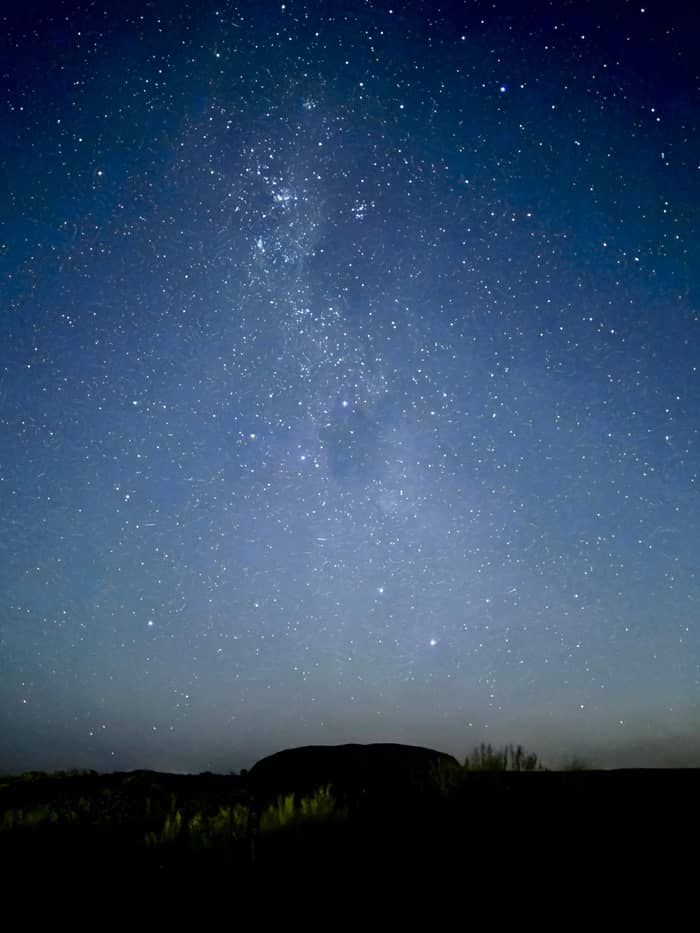
Swag nights
Swags and campfire
The tour sold on this site
- BedTraditional swag
- Luggage15 kilograms
- Water3 litre bottle
Guides
Language
Currency
Check open spotsfrom $557 · no cancel feeHands-on checklist
The quick take
There are toilets at Uluru on the base walk, the Mala and Liru walks, Talinguru Nyakunytjaku and the Kata Tjuta sunset area, but none at the dune viewing area or Walpa Gorge.
Toilets and packing
Your list · 11 items
Tick items as you finish them. We save your progress on this device.
0 / 11 ready
You are good to go. All that is left is to pick your start town and date.
Save a placeThe practical side of a camping trip decides how much you enjoy the scenery. This guide covers toilets and water in the park, the beds on offer, chores, power, and what to fit in one soft bag.
Editorial team, ulurucampingtour.com · Updated November 8, 2026 · Reading: 8 min
Main facts
Are there toilets at Uluru? Yes, but not everywhere, and knowing where they are shapes a good day in the park. Parks Australia lists toilets and drinking water on the Uluru base walk, which also has an emergency call device, and on the shorter Mala and Liru walks.1,9,10 Talinguru Nyakunytjaku, the main sunrise area, has water and toilets too, and is 35 minutes from Yulara.2 Those are the reliable stops for a morning in the park.
Several popular places have nothing at all. The Kata Tjuta dune viewing area has no water and no toilets, the Uluru car sunset area has neither, and the Kuniya walk to Mutitjulu Waterhole has no toilets either.4,7,11 Out at Kata Tjuta, the gorge walk at Walpa and the longer Valley of the Winds circuit have taps for water but no toilets, so use the block at the sunset area, which has both, before you set off.5,6,3 The rule is simple: use the toilet when you see one.
Food is even scarcer than toilets. Ininti, a cafe in the Cultural Centre, is the single spot in the park that sells anything to eat or drink, trading 8 am to 5 pm, 7 days a week, and shut by dinner.8,12 On a camping tour your guide plans the stops around these facilities, but it still pays to carry snacks and your own water on every walk. A bag of nuts and a full bottle weigh little and make a long morning far easier.
Before you leave the vehicle
| Site | Toilets | Water | From Yulara |
|---|---|---|---|
| Uluru base walk | Yes1 | Yes | At the rock |
| Mala walk | Yes9 | Yes | At the rock |
| Talinguru Nyakunytjaku | Yes2 | Yes | 35 minutes |
| Uluru bus sunset area | Yes23 | No | 15 to 20 minutes24 |
| Uluru car sunset area | No7 | No | 15 to 20 minutes7 |
| Kata Tjuta sunset area | Yes3 | Yes | 40 minutes |
| Kata Tjuta dune viewing area | No4 | No | 35 minutes25 |
| Walpa Gorge walk | No5 | Yes | At Kata Tjuta |
Facilities and drive times as Parks Australia lists them for each site; the base walk and Mala walk also have an emergency call device.1,9,7
A camping tour does not mean a week without a shower. Tourism NT notes that many national parks in the Territory have dedicated camping areas with toilets and showers, bins, barbecues and tables.15 The listing for the tour sold here does not describe its camp bathrooms in detail, so if hot water matters to you, email the operator a direct question instead of guessing from photos. A short email answers it in a day.
If you camp independently at Yulara, Ayers Rock Campground has an unheated swimming pool, communal barbecues and laundry facilities, and its powered and unpowered sites sit close to the shared amenities and water supply.16,17 Further east at Curtin Springs, showers cost $5 per person per shower for every camper, powered or not, so keep coins or a card handy.18 Water for tanks is sold there too.
Small habits keep camp life comfortable. A quick-dry towel and a pair of rubber sandals for the shower block weigh almost nothing. Wet wipes cover the day walks where there is no water, and a zip bag for rubbish matters too: Parks Australia asks visitors to take all rubbish with them, and that includes tissues and food scraps on the trail.19 Leave each site cleaner than you found it.
How much water
Beds vary more than people expect. This site's tour puts everyone in canvas swags round the fire, whereas a safari-style trip on the same route uses eco tents. Tourism NT also lists trips where you choose between a permanent safari tent and a swag.26 Read the listing's sleeping line before the price, since it decides how your nights will feel. Two trips with the same route can feel very different after dark.
Self-drivers have another set of choices. Uluru tent accommodation at Ayers Rock Campground starts with the unpowered tent site, tent only and closed to vehicles, from $30 AUD a night in low season.27,28 The Desert Camp is an unmarked, unpowered area from $45 a night with minimal shade, and its generator runs nearby day and night, so earplugs are recommended.29,30 Light sleepers should pick a regular site instead.
For a roof without a hotel bill, the campground's two-bedroom cabins sleep a family in 1 double and 4 single bunk beds, but they have no bathroom of their own.31 They start from $195 a night, with cooking facilities, linen and air-conditioning.32 Without a bathroom of its own, a cabin still means a walk to the shared amenities at night, so pack a torch either way and keep it by the door.
Comfort check
Find the line that matches your worry, then read across.
If I need a proper bed and walls
Choose an eco tent tour
One safari camping tour of the loop uses comfortable eco tents.
If I want to sleep under the sky
Book the swag tour
Open-air swag nights are built into this site's tour.
If I have a special diet
Tell the operator in advance
The 2-day listing asks for dietary needs before the trip.
If My phone is my camera
Bring a big power bank
Power at camp is limited on the tour sold here.
If I worry about toilets on walks
Plan around the facilities
Three styles of camp
Swag nights
The tour sold on this site
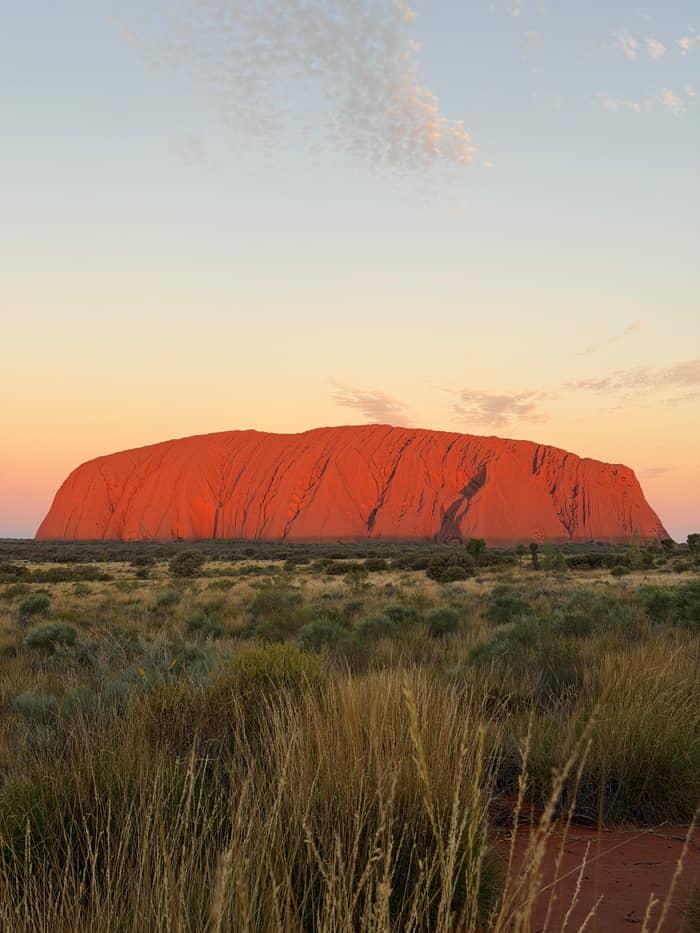
Tent nights
Same loop, tents
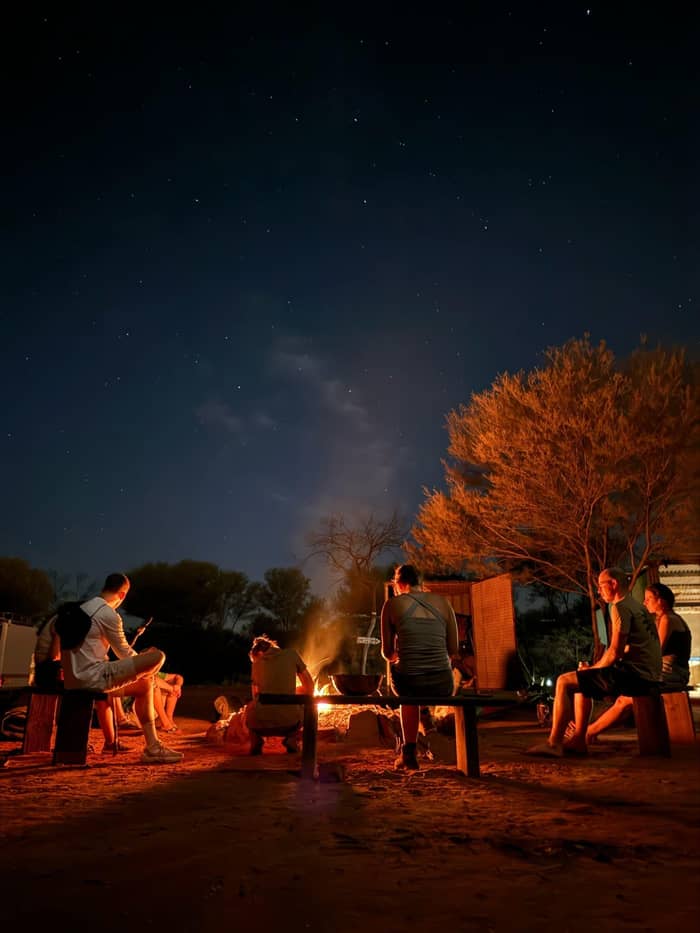
2 days
Help with meals and camp
Expect to pitch in on a camping trip. Tourism NT describes guests helping the guide with meal preparation and bush cooking, and one 2-day Uluru camping listing says plainly that guests are expected to help with meals and with setting up camp.38 The 4-day swag trip adds collecting firewood and cleaning up after dinner. It is part of the experience, and washing-up duty is a quick way to get to know the rest of the group.
Tell the operator about food needs early. The 2-day listing asks guests to share dietary needs and medical conditions in advance, and the earlier you share them, the easier the meals are to plan. Vegetarian or gluten-free meals are easy to cook over a camp stove when planned; they are hard to improvise at a remote camp. Bring a few snacks you know you like for long drives between towns.
The fire is the centre of camp life, and it comes with rules. The NT emergency service says to light fires only in designated fireplaces and to carry a gas barbecue in case of a total fire ban.39 At Curtin Springs, campfires are allowed if you bring your own firewood, and the station asks visitors not to cut its trees.40 On a tour, the guide decides where and when the fire is lit and when it is put out.
Camp style and price
Set the camp style and your group size to see what the trip costs from.
4 options compared
Set the camp style and your group size to see what the trip costs from.
≈
View≈
View≈
View≈
ViewAll amounts are from-prices on GetYourGuide, converted at the ECB reference rate. Exact prices are shown at booking.
A day at camp
Before dawn
Roll the bed, fill the water bottle, find the head torch.
Morning
Walks happen early to avoid the afternoon heat.13
Midday
The hot hours go on driving, eating and resting.14
Afternoon
Top up water and power where you can.
Evening
Guests help with meals, firewood and the washing-up.
Electricity is the thing campers miss most. The tour listing warns that power at camp is limited and asks guests to bring a power bank, and a safari camping tour gives the same advice. Parks Australia's own tech list for a visit includes a portable power bank and an Australian electrical adaptor.41 Charge everything in town the night before the pickup and keep cables in your daypack.
Phone signal is patchy in the park. Parks Australia rates Telstra as the strongest network there, with gaps that are worst near Kata Tjuta.37 At Yulara you get Telstra, Optus and Vodafone, and most accommodation at Ayers Rock Resort, including the campground, offers wi-fi, though it may not be included in the rate.42,43 Download maps and guides before you leave town, while the signal is strong.
Treat the trip as a short break from the screen. Use airplane mode on long drives to save battery, keep the phone warm inside your sleeping bag on cold nights, and save photos to a memory card rather than the cloud until you are back in range. If you need to be reachable, give family the operator's office number and the tour's end date rather than promising to check messages every evening.
Video
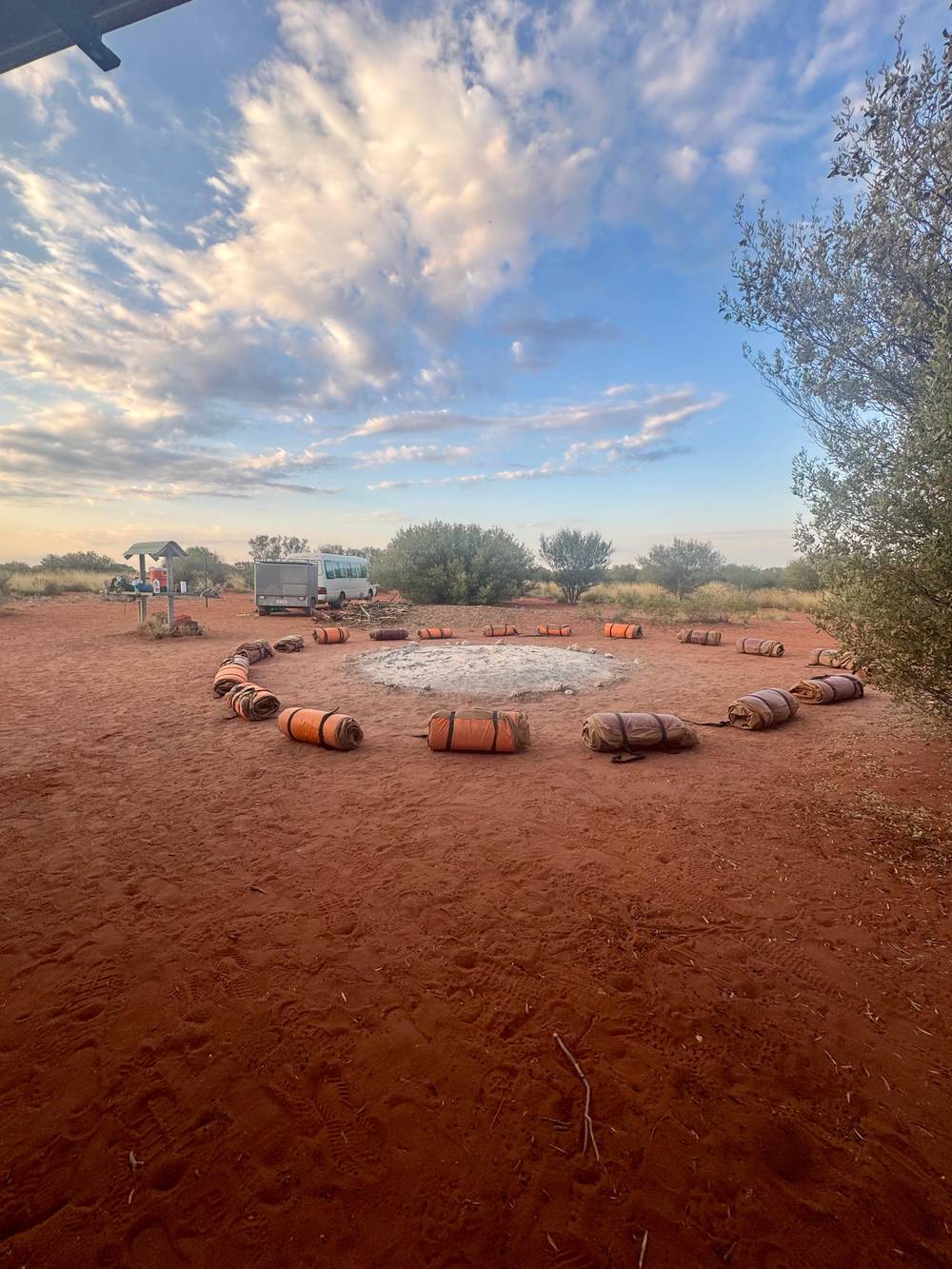
Chasing Dain on YouTube · The video waits until you tap play to load.
Eat regular meals, take frequent breaks and eat plenty of healthy snacks, even if you don’t feel hungry.
Water is the most important thing you carry. The rangers' rule of thumb is a minimum of one litre for every hour on foot, per person, and the tour wants every guest to arrive with a 3 litre bottle.22 The NT emergency service sets a floor of at least 2L a day in the Territory, more if you are outdoors or exercising.20 On a hot walking day, those numbers add up quickly, and a refill point is never far from mind.
What you drink matters too. Skip sports drinks, diet cordial and coffee on walking days, as Parks Australia warns they can dry you out further, and carry electrolyte sachets to put back what sweat removes.44,45 It also asks visitors to eat regular meals and plenty of healthy snacks even when they do not feel hungry, and to walk with another person at all times.14,46 Sound advice for camp too, where the day starts early and ends late.
Heat shapes the daily rhythm of camp. Rangers say summer walkers should be done by 11.00 am, and that any hike between 2.30 pm and the cooler 6.30 pm is best skipped all year.13 On a camping tour the day bends around it: walks tend to happen at dawn, the hot middle of the day goes on driving and resting in the shade, and the evening belongs to the campfire and the bright stars above it once the last dishes are done.
Space is the first limit. On the tour sold here your main bag, soft and no larger than medium, may weigh up to 15 kilograms, with a daypack kept by your seat. A 2-day camping trip sets the same idea in numbers: 1 bag of 15 kg and 1 daypack of 5 kg. Pack soft, pack light, and leave anything extra with your hotel in town if it offers luggage storage. Roll clothes rather than fold them.
For walking, Parks Australia's list starts with sturdy walking shoes, a broad-brimmed hat, sunscreen and lip balm, and recommends long, lightweight clothing for sun and insect protection.36,34 Then a fly net for your face, and in the cool months enough warmth for frosty dawns, hat and gloves included.35,33 The tour adds a torch and insect repellent or a fly net to the list. Tick each item off before the pickup.
Forgot something? The supermarket and shops around the Yulara town square are about a 15-minute walk from Ayers Rock Campground.47,48 Yulara also has a medical centre, booked through hotel reception, along with a petrol station and a police station.49 If you start in Alice Springs, do your shopping there the day before, since the pickup comes early and the shops in town will still be shut.
FAQ
Parks Australia lists water, toilets and an emergency call device on the base walk.1
Your soft main bag stays under that weight, and a daypack rides with you.
Charging points are scarce at camp, so the tour asks for your own battery pack.
Telstra has the best coverage in the park, with black spots around Kata Tjuta.37
Tourism NT lists Uluru camping trips that offer permanent tents at Uluru as well as swags, so guests can pick walls or open sky.26
One 2-day listing says guests help with meals and setting up camp.
Sources
Cold nights or long walks worrying you? Ask a real person here.