Swag nights
Swags by the fire
The tour sold on this site
- Length3 days
- BedTraditional swag
- BringTorch, power bank
Guides
Language
Currency
Check open spotsfrom $557 · no cancel feeHands-on checklist
Your list · 10 items
Tick items as you finish them. We save your progress on this device.
0 / 10 ready
You are good to go. All that is left is to pick your start town and date.
Save a placeA swag is the simplest bed in the outback and the reason many people book a camping tour. Here is what swag camping at Uluru feels like after dark, how cold it gets, and how to sleep well.
Editorial team, ulurucampingtour.com · Updated November 8, 2026 · Reading: 8 min
Main facts
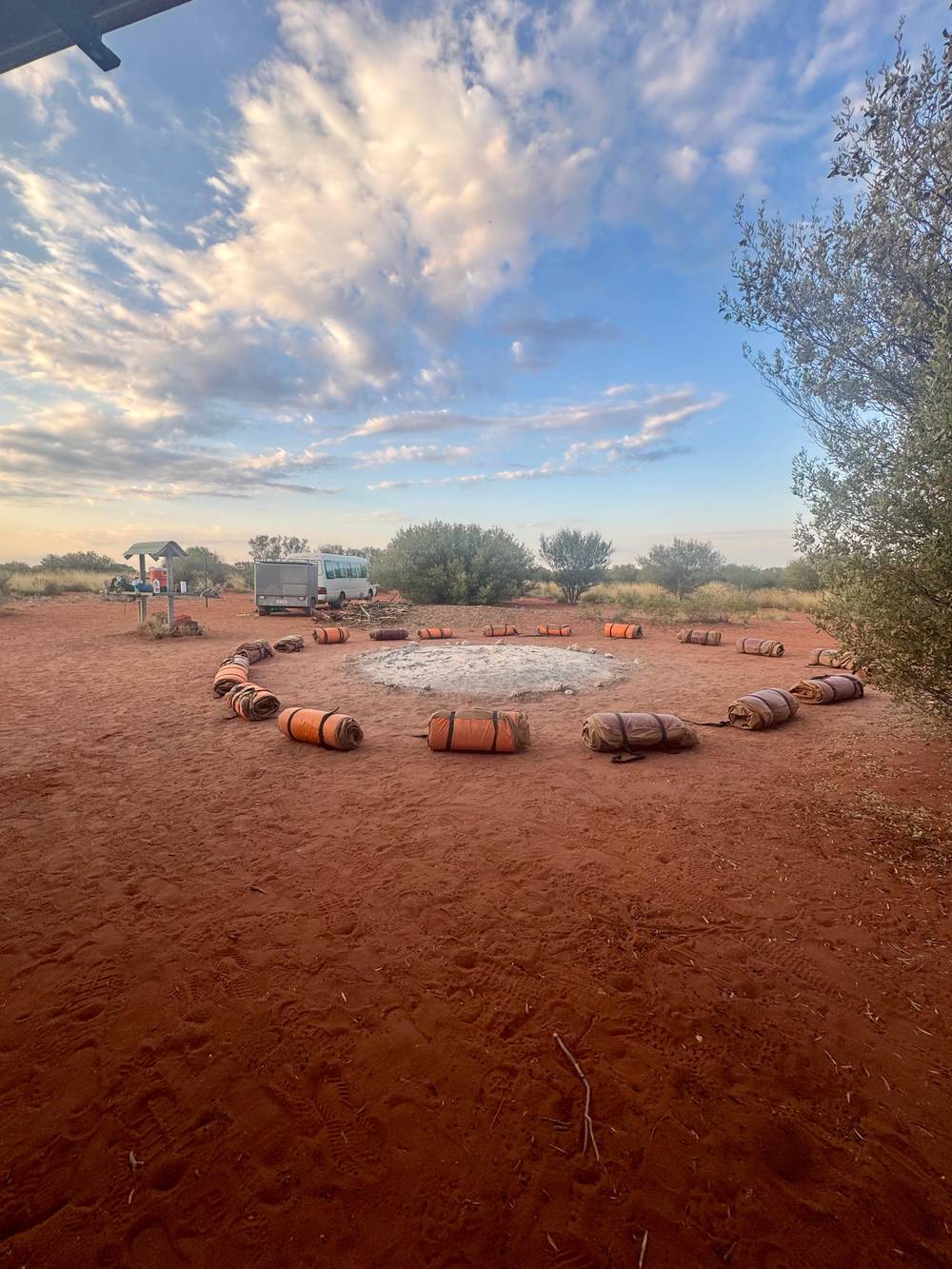
Tourism NT describes a traditional swag as a canvas-covered bedroll, and that is the whole idea: a thick mattress wrapped in a heavy canvas cover that you unroll on the ground, climb into with a sleeping bag, and zip or fold closed against the wind.1 There is no frame and no roof over your face unless you pull the flap up. You look straight at the sky until you fall asleep, and you wake when the first light reaches the sand.
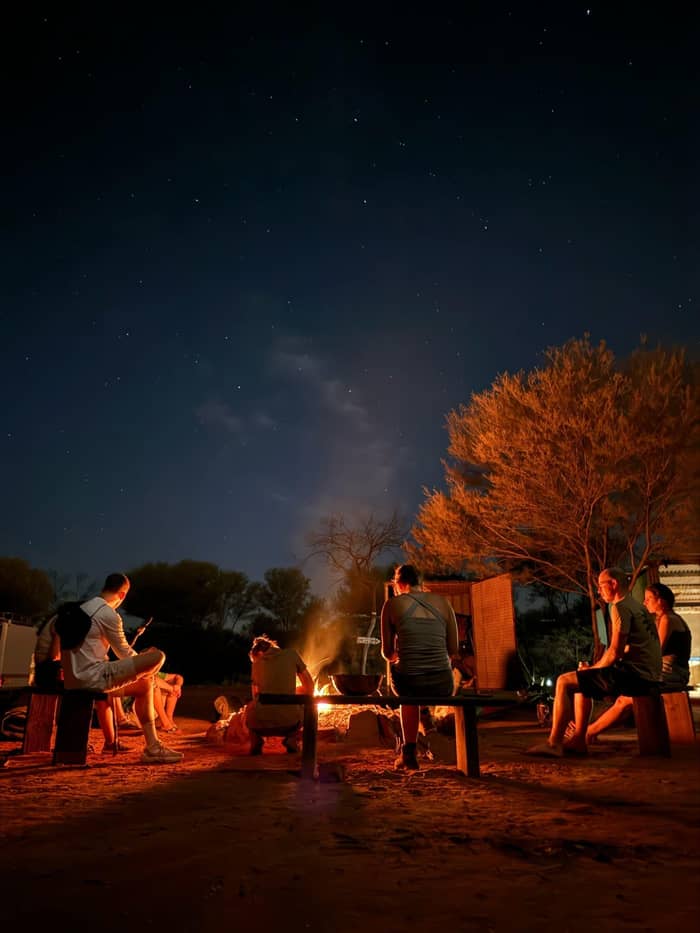
On the 3-day tour sold on this site, the bed for every night is a traditional swag laid out near the campfire, and the trip is built around it. A longer 4-day trip spells out what that involves: sleeping on the ground in a swag, collecting firewood, helping cook and cleaning up afterwards. Expect a shared camp, a fire that the group keeps going, and a bed that is ready in a minute because it never needs pitching.
Swags are not only for budget trips. Even at Longitude 131, the luxury tented camp near the rock, a swag can be rolled out on a guest's private balcony for a night in the open air.5 The difference on a camping tour is that the swag is the bed, not an evening novelty. That is the experience this page is about: a long desert night with nothing between you and the sky but canvas, a sleeping bag and whatever layers you remembered to bring.
Two stations, one message
| Month | Yulara low (BOM) | Uluru Rangers low (NOAA) | Swag advice |
|---|---|---|---|
| May | 9.3 °C2 | 9.1 °C8 | Fleece and a warm bag |
| June | 5.6 °C2 | 6.5 °C8 | Thermals, beanie, gloves |
| July | 4.4 °C2 | 4.7 °C8 | Coldest: layer everything |
| August | 5.9 °C2 | 6.6 °C8 | Thermals, beanie, gloves |
| September | 10.7 °C2 | 11.2 °C8 | Fleece for the small hours |
Yulara figures are Bureau of Meteorology averages published by Parks Australia; Uluru Rangers lows are NOAA means over 1991 to 2020.2,8
The Red Centre surprises people in winter, when clear desert days hide how cold the nights become. The Bureau of Meteorology averages that Parks Australia publishes for Yulara put the July low at 4.4 °C, with June at 5.6 °C and August at 5.9 °C.2 Those are averages, not the worst nights. According to Parks Australia, a winter night here may bottom out at -7 °C, and frost whitens the sand on clear mornings.3,7
A second record, from NOAA's ranger station gauge 2.5 km from Uluru, points the same way: the average July low there is 4.7 °C, while the average July high is only 20.2 °C.8 The two stations sit in the same dunes but use different years and methods, so read each number as a feel for the season, never as tonight's forecast. The pattern is the point: clear dry air lets the day's warmth escape fast once the sun drops.
In the Anangu calendar this stretch is wari, roughly late May into July, a dry spell with frost or dew on some mornings.7 Parks Australia explains that frosts are common in this season when high pressure brings cooler dry air and the ground loses heat to a clear sky overnight.9 The Northern Territory emergency service goes further and warns that extreme cold in the southern region can be just as dangerous as heat in the north.10 Respect a winter swag night and dress for it.
Night and day at the rock
Sunless hours around mid-month and the count of days with 2.5 mm or more of precipitation. NOAA, station Uluru Rangers, 1991 to 2020.8
In the hot months the problem flips. Yulara's average January low is 22.8 °C and December's is 20.8 °C, so a swag in summer is about staying cool enough to sleep rather than staying warm.2 Parks Australia warns that October to March can be extremely hot, with days regularly above 35 °C, and the evening often stays warm long after sunset.12 Many campers sleep on top of the sleeping bag and pull it over only before dawn.
From late October Anangu speak of mai wiyaringkupai, or kuli, the hot time of year, when thunderheads build and flash yet drop little water.13 A swag's heavy canvas cover keeps off a passing shower, yet a desert storm can still mean wind, dust and a short wet spell. Listen to your guide on stormy evenings and keep loose gear inside the vehicle; tour itineraries can change for weather extremes, and the camp plan can change with them.
Insects are the other summer guest. The NT emergency service notes that mosquitoes are active around sunset and recommends a repellent with DEET.6 By day it is flies, and Parks Australia says summer brings them in large numbers, which is why head nets are sold on arrival.11 Close the swag's flap at dusk, eat with a light that is not pointed at your face, and keep repellent in the pocket of whatever you sleep in.
Swag or not
Start with the worry you have; the answer on the right fits it.
If I feel the cold badly
Travel outside June to August
July lows average 4.4 °C at Yulara, and nights can fall to -7 °C.2,3
If I want the sky above me
Book the swag tour
The 3-day tour beds everyone down in swags around the fire.
If I am a light sleeper
Choose eco tents
A safari version of the loop puts guests in eco tents.
If I hate insects
Pack a head net and repellent
Mosquitoes rise at sunset and summer brings large numbers of flies.6,11
If I travel in January
Expect warm nights
January lows average 22.8 °C, so a light layer is enough.2
Three ways to spend the night
Swag nights
The tour sold on this site
Ages 18 to 49
Swags on the ground
Tent nights
Walls around your bed
The tour's kit list fits on a napkin: winter warmth, a torch, something against insects, a 3 litre bottle and a battery pack for your phone, with only limited charging at camp. Your whole kit must come in under 15 kilograms, packed soft, plus a daypack, so every layer has to earn its place. Pick clothes that stack: thermals, a mid-weight fleece and a shell against the wind weigh little and cover the whole range of desert nights.
Parks Australia's packing page backs this up, asking for extra warmth for chilly nights and dawn starts, with hat and gloves added in winter.4 For campers at Ayers Rock Campground it lists a sleeping bag, chairs and a head torch.14 Tourism NT gives the same message from another angle: anyone sleeping out between autumn and spring needs warm clothes and real camping gear.15 Every source agrees on this.
Small things make the biggest difference in a swag. The 4-day swag tour asks guests to bring a small pillow, a face fly-net, sunglasses and sunscreen, and to wear layers for the changing temperatures. A beanie keeps more warmth in than an extra blanket, dry socks kept only for bed feel like luxury, and a head torch on a red setting lets you find things without blinding the person in the next swag.
Swag or tent, priced
Choose swag or tent, set your group size, and the total from-price appears.
4 options compared
Choose swag or tent, set your group size, and the total from-price appears.
≈
View≈
View≈
View≈
ViewAll amounts are from-prices on GetYourGuide, converted at the ECB reference rate. Exact prices are shown at booking.
From dusk to dawn
Sunset
The group gathers wood, the fire is lit and swags are unrolled nearby.
Dusk
Mosquitoes are active around sunset; repellent goes on before dinner.6
After dinner
Layers on, beanie on, flap open to the sky.4
Small hours
Clear winter nights can fall below freezing.3
Before dawn
Sunrise opens the second day of our tour, so the alarm is early.
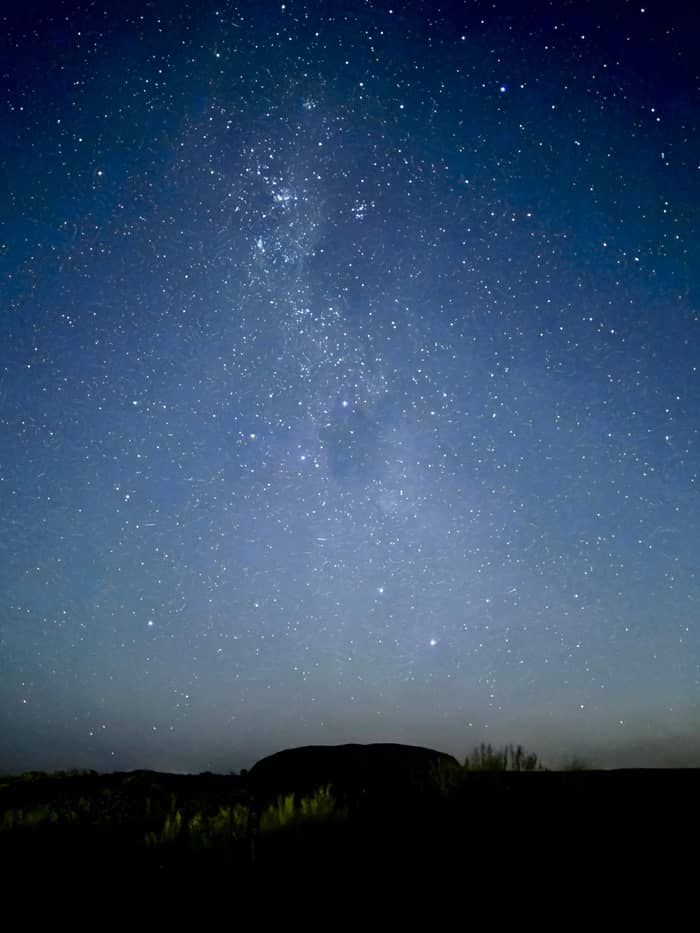
For many people this is the reason to choose Uluru camping under the stars over a hotel bed. Parks Australia rates the region's dark skies highly for night photography, and Uluru's outline under the Milky Way is now an Australian classic.16,17 From a swag you do not need a camera to enjoy it; you simply lie back and watch the stars wheel slowly overhead as the long desert night goes on.
Nobody stays inside the park after the gates shut, which means every star photo of the rock is taken from beyond the boundary.18 The rangers suggest a raised dune lookout on the Lasseter Highway, roughly midway from the resort to the park entry.19 Camping tours spend the night at a camp rather than inside the park, which suits stargazing: the fire dies down, the group drifts off and the sky takes over.
A few habits help. Let your eyes adjust by keeping torches dim after dinner, and step a little away from the fire's glow before you look up. On moonless nights the band of the Milky Way is plain to see; around full moon the sky is brighter and fewer stars show. Sleep with your camera or phone inside the sleeping bag on cold nights, since batteries drain quickly in the chill and you will want them charged at sunrise.
Video
Out and About on YouTube · The video waits until you tap play to load.
Frosts are common during this season when high pressure systems move through the area combining cooler dry air with nocturnal radiation.
The desert is busier after dark than by day. Parks Australia notes that dingoes are more active at night than during the day, and although they are generally very shy of people, they can be curious and watch from a distance.20,21 They are wild animals: never touch or feed one, and keep food packed away rather than beside your swag.22 A dingo trotting past the edge of camp is a sighting to remember, not a threat to invite closer.
Smaller animals come out too. Spinifex hopping mice are usually seen at night, bouncing across open sand, and the brush-tailed mulgara, a small carnivorous marsupial, hunts at night for insects and spiders.23,24 The woma python is mostly nocturnal and spends the day resting in logs or under leaves.25 Tracks in the sand next to your swag in the morning are part of the fun of sleeping on the ground.
Snakes are the reason for a torch. Parks Australia says the king brown snake tends to avoid people and will usually only bite if disturbed.26 Shake out boots before you put them on, use a light when you walk to the toilet block, and never reach into a gap you cannot see. Uluru swag camping with a guide also means someone who knows the local wildlife is a few metres away, which makes the first night far less daunting.
Not every camping tour uses swags, so read the sleeping line of a listing first. Tourism NT shows Uluru trips that let each guest pick a fixed safari tent or a classic swag, and a 3-day trip from Alice Springs offers the same choice.27,28 One safari camping tour of Uluru, Kata Tjuta and Kings Canyon uses comfortable eco tents, and a 2-day safari camping trip sleeps guests in a powered camp.
A swag suits you if you sleep well anywhere, want the sky above you and do not mind the cold for a few hours before dawn. A tent suits light sleepers, people travelling in the coldest weeks, and anyone who wants walls around their bag. Both share the same campfire, the same meals and the same early starts, so the choice is about one thing only: how you want to spend the hours between dinner and sunrise.
If you are still unsure, the decision table below matches the usual worries to an answer, and the price tool at the top of the page shows what each type of tour costs for your group. Check the season first, then the bed, then the price. Midwinter and midsummer swag nights barely resemble each other, and the gear you pack should follow the calendar far more closely than the brochure.
FAQ
Tourism NT describes the traditional swag as a canvas-covered bedroll you lay out under the open sky.1
Every night of the 3-day tour is spent in a swag near the fire.
Sleep in thermals and a hat; Parks Australia lists gloves and warm layers for winter nights and dawns.4
The gates close at night, so stargazing happens beyond the boundary.18
Some Uluru camping trips offer a permanent safari tent or a swag, and one safari tour uses eco tents.27
Sources
Cold nights or long walks worrying you? Ask a real person here.