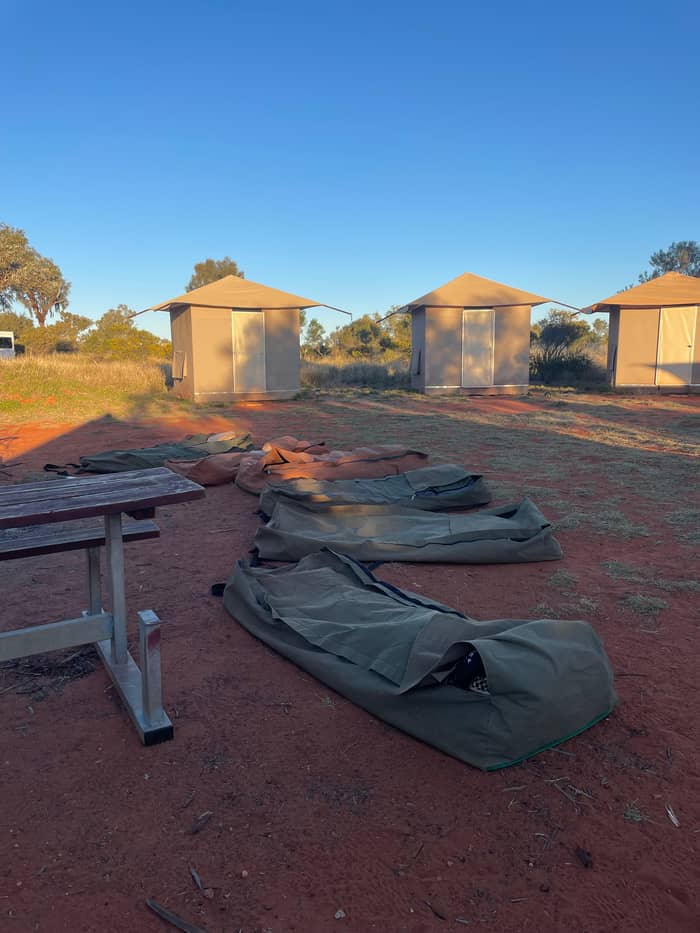
Shortest
The one-night trip
Uluru and Kata Tjuta
- Length2 days
- FinishesYulara
- SleepSwag or eco tent
Guides
Language
Currency
Check open spotsfrom $557 · no cancel feeMake-your-mind-up tool
3-day camping tour: Uluru, Kata Tjuta and Kings Canyon
★ 4.8 · 385 reviews total
Two questions, one camping trip
Say how many days you can give and what you want from them, and a trip appears with its starting price.
Recommended for you
from $536
Uluru and Kata Tjuta with a swag or eco tent, finishing in Yulara.
Recommended for you
from $557
Kata Tjuta, Uluru at both ends of the day and the Kings Canyon Rim Walk, with a Yulara or Alice Springs finish.
Recommended for you
from $628
Starts in Alice Springs or Yulara and returns to Alice Springs along the Mereenie Loop Road.
Recommended for you
from $588
Four days for ages 18 to 49, with camps near Uluru, at Kings Creek Station and at Curtin Springs.
The best Uluru camping tours differ less in price than in shape: how many nights, where you join, which walks you do and who you share the fire with. Here is how to choose.
Editorial team, ulurucampingtour.com · Updated November 8, 2026 · Reading: 7 min
Main facts
Every camping trip in the Red Centre promises Uluru, a sunset and a night under the stars, so judge them on the details that differ. Look at which walks each day includes, whether you finish where your flight leaves, what you sleep in, and who the trip is built for. Tours with the same fare can feel completely different once you see how the hours are spent, and the listing pages hide most of that in their small print.
Distance is the hidden cost. By road the rock lies 465 km south-west of Alice Springs, roughly 5.5 hours non-stop, and the canyon camp is a further 3 hours or so away.3,4 A trip that starts in Alice Springs spends much of its first morning on the highway. A trip that starts at Yulara begins at the park gate, but you have to fly there first.
The group matters as much as the route. Some trips say plainly who they are for: the Rock to Rock tour is recommended for travellers aged 18 to 49 who sleep on the ground and share the cooking. Others welcome a wider mix, and reviewers of the tour on this site praise the guide above all, with a score of 4.8. Read the age and fitness lines before the price.
The camping trips side by side
| Trip | Starts | Finishes | Sleep |
|---|---|---|---|
| 2-day safari camp | Yulara | Yulara, about midday | Powered camp |
| 2-day camping trip | Alice Springs or Yulara | Yulara only | Swag or eco tent |
| Our 3-day loop | Alice Springs or Yulara | Alice Springs or Yulara | Swag by the fire |
| 3-day via Mereenie Loop | Alice Springs or Yulara | Alice Springs | Ask the operator |
| 4-day Rock to Rock | Alice Springs or the airport | Ayers Rock Airport | Swag on the ground |
| 4-day with the ranges | Alice Springs or Yulara | Alice Springs only | Safari tent or swag |
Start and end points as each listing states them; check the option you book, as some trips run in both directions.
An Uluru camping tour of 2 days spends a single night at camp and covers the park itself. The safari camping version picks you up at Yulara or the airport between 1:15 and 2 pm, takes you on a guided walk at Kata Tjuta, then to Uluru for sunset with a light snack. Next morning: dawn at the rock, a stop at a cultural site, then the whole circuit of its base on your own, and you are back at Yulara by about 12:00.
That timing shapes your flights. The listing says outbound flights should leave after 12:30, so a midday departure on the second day works. The other 2-day listing joins from Alice Springs or Yulara, offers a swag or a permanent eco tent, and finishes in Yulara only. It reaches Mutitjulu Waterhole, Kuniya Piti and Kantju Gorge by name, and averages 4.7 from 57 reviews.
The short trip suits a traveller who has already planned other things in Australia and wants the camping night without giving up a third day. What it skips is Kings Canyon, and with it the long drive north through the desert. If the canyon matters to you, or if you want a second sunrise, the extra day is worth more than its price difference suggests.
Month by month
Sunless hours around mid-month and the count of days with 2.5 mm or more of precipitation. NOAA, station Uluru Rangers, 1991 to 2020.6
The 3-day trip is the format the tour on this site follows. Kata Tjuta and an Uluru sunset open it; day two is dawn, ancient paintings, the circuit of the rock and the Cultural Centre, before a coach ride of 3 hours north to camp near Watarrka. Kings Canyon fills the final morning with a guide, and then 4 hours on the road.
It can end two ways: on the 2-night option you are in Alice Springs for dinner, around 6 pm on day 3, and on the 3-night option you wake once more near the rock and leave Yulara around 9 am on day 4. A separate 3-day listing also ends in Alice Springs, but returns along the Mereenie Loop Road and offers a shuttle from Kings Canyon to Yulara for those who need it.
A 3-day loop gives you the rhythm that makes camping worth it: a pair of dawns, a pair of nights by the fire, and enough time on foot to understand the scale of the place. At 348 metres high and 9.4 km in circumference, the rock is only understood once you have walked beside it.8,9 The itinerary page on this site walks through each day hour by hour.
Three lengths
Shortest
Uluru and Kata Tjuta
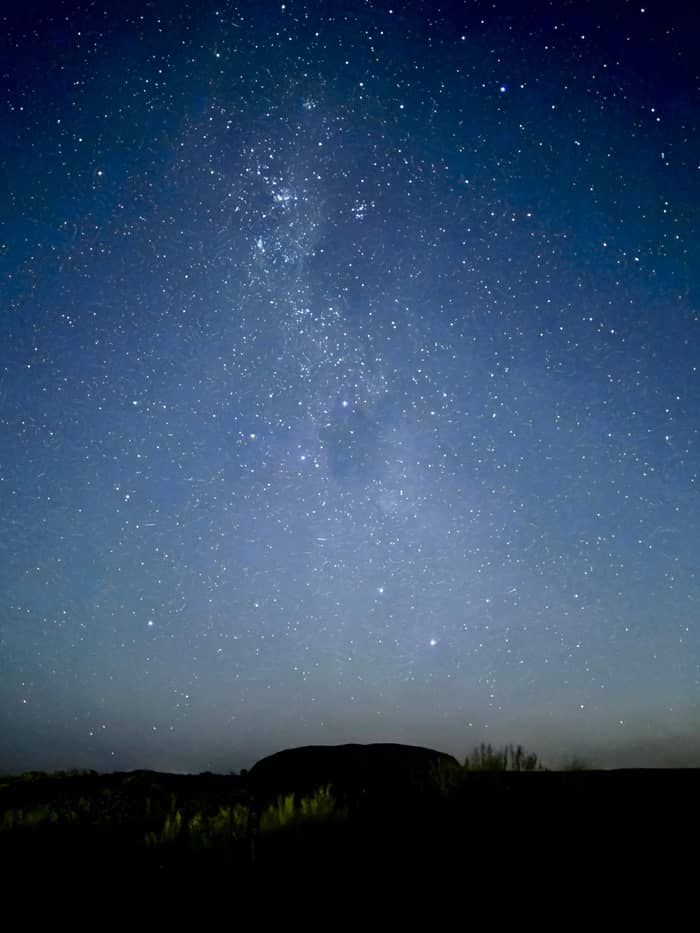
Adds Kings Canyon
Our pick
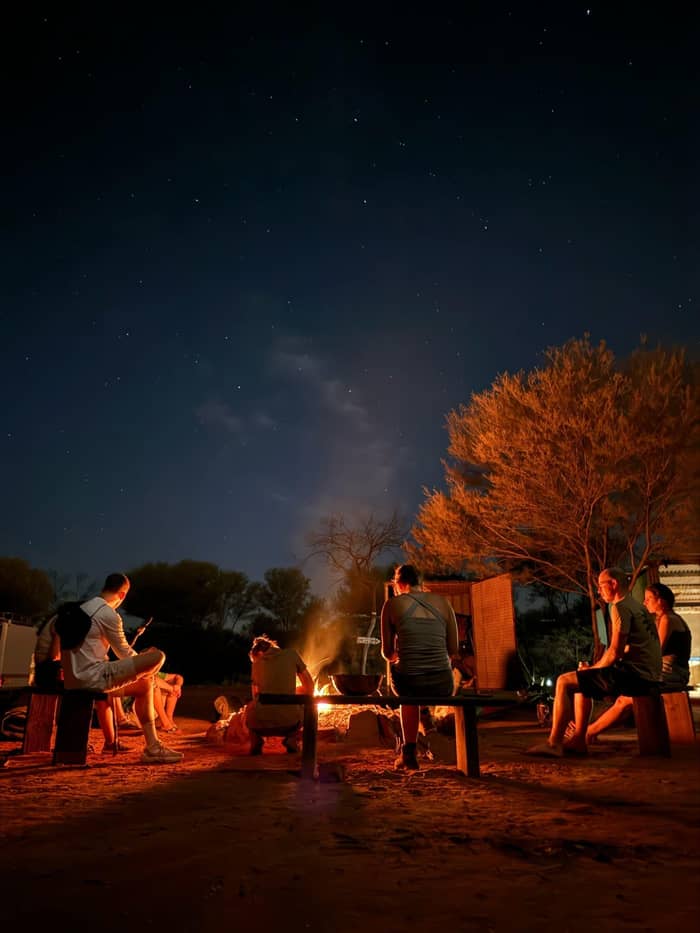
Wildest camps
Ages 18 to 49
An Uluru camping tour of 4 days does not simply add a rest day; it adds country. The Rock to Rock trip camps near Uluru, at Kings Creek Station and at a bush camp on Curtin Springs Station, and ends at the airport at about 10:00 AM on the last day. Guests sleep on the ground in swags and help with firewood, cooking and cleaning up.
The other 4-day trip heads north after Kings Canyon to the West MacDonnell Ranges and finishes in Alice Springs only. Guests pick a twin safari tent or a bush swag; night one is spent at the resort campground with shared bathrooms, after roughly 460 km on the road. Walks run 2 km to 6 km a day, with one longer walk of about 12-15 km.
Choose the longer trips if you like the road as much as the rock, or if you want to end somewhere other than where you started. Skip it if you have only a week in Australia, or if early starts on consecutive days sound like work. The extra night adds a lot of driving, and the payoff is wilder camps rather than more time at Uluru itself.
Compare the fares
Enter your group and line up the fares of one, two or three nights out.
3 options compared
Enter your group and line up the fares of one, two or three nights out.
≈
View≈
View≈
ViewAll amounts are from-prices on GetYourGuide, converted at the ECB reference rate. Exact prices are shown at booking.
Choose in order
First
May to September brings days of 20 to 30 C; nights are cold.1,5
Second
Two days for the park, three to add Kings Canyon, four for wider country.
Third
Alice Springs at about 6 am, or Yulara in the early afternoon.
Fourth
Age ranges, fitness and doctor notes differ by operator.
Fifth
Our tour refunds up to 7 days ahead; others ask 14 days.
Starting in Alice Springs means a pickup near 6 am and 4.5 hours on the road to Yulara. You see the desert change, stop for an early lunch and reach Kata Tjuta in the afternoon. Starting at Yulara means meeting the group between 1:40 and 2 pm, so your plane has to be down by 1:45 pm. Book flights after you know the start town, not before.
Alice Springs is the better start if you are already in the Northern Territory or arriving by train, since the train from Adelaide reaches Alice Springs in around 21 hours.10 Yulara is the better start if you are flying in from the east coast: you can fly directly there from Sydney, Melbourne, Brisbane and Cairns.11 Daily flights also link Uluru, Alice Springs and Darwin.12
Think about the end as much as the start. A trip that finishes in Alice Springs at 6 pm usually means a night there before you fly out. A trip that finishes at Yulara in the morning lets you catch a flight the same day, and our tour drops you at your Yulara bed or at the terminal. The getting-there guide covers both towns in detail.
Video
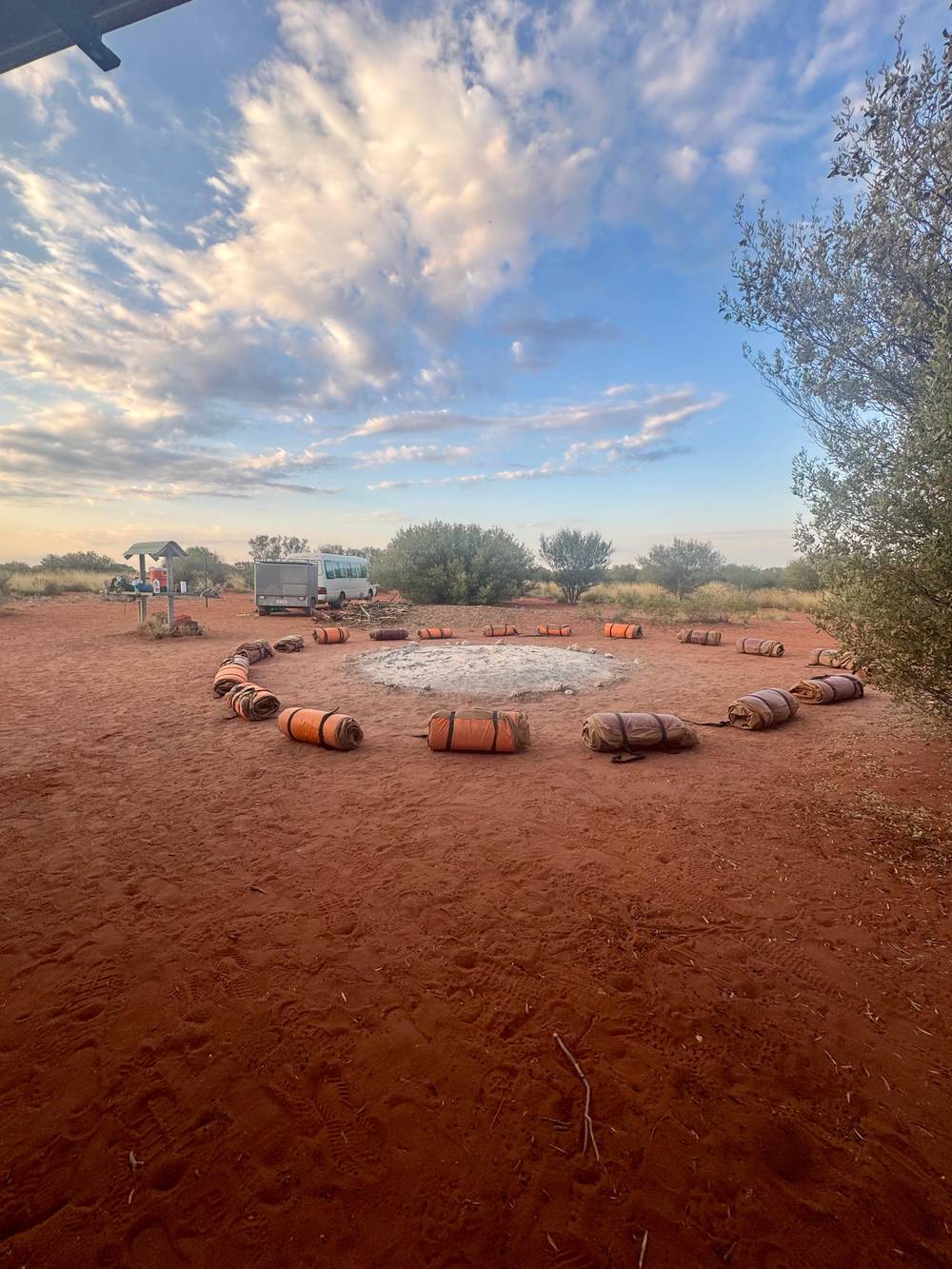
Go with Kelly on YouTube · The video waits until you tap play to load.
The Valley of the Winds Walk closes at the first lookout (Karu Lookout) from 11 am when the forecast or actual temperature reaches 36 degrees Celsius and above.
Before you choose
Every camping trip here involves real walking, much of it on rock and sand with little shade. Circling Uluru means 10.6 km on a Grade 3 loop, allow 3 hours 30 minutes.2 Walpa Gorge at Kata Tjuta is shorter, 2.6 km there and back, about an hour on foot; the full Valley of the Winds circuit, by contrast, takes 3 to 4 hours.13,14
Operators set their own bar. One 3-day listing asks for a moderate to advanced fitness level, with walks of 2 km to 4 km each day, and requires a doctor certificate for travellers over 75. The 2-day listing from Alice Springs mentions walks of 2 to 15 km. If you can walk for a few hours on uneven ground in the sun, you can do any of them at your own pace.
Heat changes the plan more than fitness does. Once a forecast or reading of 36 C or more arrives, rangers shut the Valley of the Winds beyond Karu Lookout from 11 am.7 Rangers also want each walker drinking a litre or more every hour.15 Expect early starts on every camping trip, with the walking done before the heat builds.
The park authority picks May to September, when daytime maximums usually land between 20 C and 30 C.1 The same months bring the coldest nights: the July mean minimum at the ranger station is 4.7 C, and frosty nights reach minus 7 C.6,16 In a swag that is a serious cold, so check what bedding the operator gives you.
October through March, afternoons often go beyond 35 C and the flies arrive in force.17,18 The mean January maximum at the station is 38.2 C.6 The hottest stretch, late October to December in the Anangu calendar, brings storm clouds and lightning but little rain.19 A summer trip can still be good, as long as you accept very early starts and long, hot afternoons in the shade.
Shoulder months are a good compromise. In April the average high at the station is 30 C and the low 14.7 C, and in September 28.8 C and 11.2 C, warm enough for comfortable nights and cool enough for long walks.6,6 Wildflowers usually peak in August and September.20 Pick your month first, then look for the tour length that runs on your dates and fits your fitness.
FAQ
Three landscapes in one loop, with the canyon at the end; our listing averages 4.7 from 385 reviews.
It covers Kata Tjuta, sunset, sunrise and the base walk, but skips Kings Canyon.
One adds Curtin Springs and Kings Creek Station, another the West MacDonnell Ranges.
From Alice the pickup is about 6 am; from Yulara between 1:40 and 2 pm.
The Rock to Rock trip is recommended for ages 18 to 49; others need a doctor note over 75.
The 2-day trip offers a permanent eco tent; an eco-tent version of our loop also exists.
On days of 36 C or more the Valley of the Winds shuts past Karu Lookout from 11 am.7
Sources
Cold nights or long walks worrying you? Ask a real person here.